
Scholarly publishing is experiencing a very different kind of pressure than it was even just five years ago.
Submission volumes are continuing to rise across many disciplines, and reviewer fatigue remains a persistent challenge, while research integrity concerns are becoming more visible – and far more resource-intensive to manage well.
At the same time, editorial teams are being asked to absorb new technologies, changing submission behaviours, and the increasing integrity demands without letting workflows become unstable – or worse, fracture entirely. All this, while working within already-stretched operational structures.
I’ve noticed from the conferences I’ve attended that much of the industry conversation surrounding peer review has, understandably, focused on artificial intelligence. New tools are emerging at a remarkable speed, offering support across areas such as manuscript screening, image analysis, reference validation, plagiarism detection, and workflow automation. Some of these tools are proving useful in practice, but others still struggle against the realities of editorial workflows, which are usually far messier and more nuanced than software marketing implies.
What many publishers are discovering, however, is that technology alone does not resolve these pressures.
The challenge facing publishers is not simply one of speed or efficiency. It’s one of interpretation, oversight, consistency, and trust. We know that editorial workflows are rarely linear in practice. For example, a delayed reviewer invitation may create downstream bottlenecks, and a backlog can simultaneously affect editor responsiveness, author satisfaction, and production timelines. In conjunction with this, research integrity concerns are no longer confined to occasional isolated cases, but are now influencing how journals think about triage, reviewer selection, image screening, archive oversight, and editorial accountability as a whole.
Against this backdrop, the role of experienced human editorial support has arguably become more important – rather than less.

At PA EDitorial, I’ve seen firsthand how closely operational pressure, research integrity, workflow management, and editorial decision-making are now connected. In practice, these issues rarely exist separately. Operational strain, editorial complexity, technological change, and integrity oversight tend to overlap, often placing considerable pressure on editorial teams who are expected to maintain quality, consistency, and responsiveness across all areas simultaneously.
This has led us to think carefully about how editorial support should function within modern publishing workflows. Rather than treating these as separate challenges, we believe they should be seen as interconnected parts of the same editorial ecosystem.
Our core peer review management services remain central to this approach. Across a broad portfolio of academic journals, we support editorial offices with submission checks, reviewer coordination, editor support, acceptance processing, reporting, and day-to-day workflow management. However, in providing this core service, it has become increasingly clear that many publishers and editorial teams no longer require support in only one fixed format. Some journals need full end-to-end management, while others need support in specific areas, such as reviewer selection, backlog recovery, onboarding, or post-decision processing. Generally, editorial strain rarely affects every stage of a workflow equally.
Listening to the concerns facing scholarly publishing, it is clear that, flexibility matters just as much as scale because pressure rarely exists evenly across an entire workflow. Instead, bottlenecks tend to emerge in specific operational areas, often shifting over time in response to submission volume, reviewer availability, editorial capacity, or wider organisational change.

PA EDitorial Select was developed with this in mind. Rather than operating as a rigid end-to-end peer review management model, Select provides modular editorial support tailored to areas where journals may be experiencing workflow strain or requiring additional operational resilience. This can include:
• backlog management
• reviewer selection support
• post-decision processing
• journal onboarding
• transitional support during periods of organisational or platform change.
The aim is not only to reduce workload, but to maintain continuity and editorial stability during periods of pressure without introducing unnecessary complexity or fragmentation into the workflow itself. In many cases, thoughtful operational support behind the scenes can make a significant difference to the experience of editors, reviewers, and authors alike.
At the same time, research integrity considerations are becoming embedded much earlier within the editorial process than they once were. Increasing submission volumes, the rise of AI-assisted writing tools, paper mill activity, manipulated images, and broader concerns around publication ethics have all contributed to a growing need for more structured early-stage manuscript assessment.
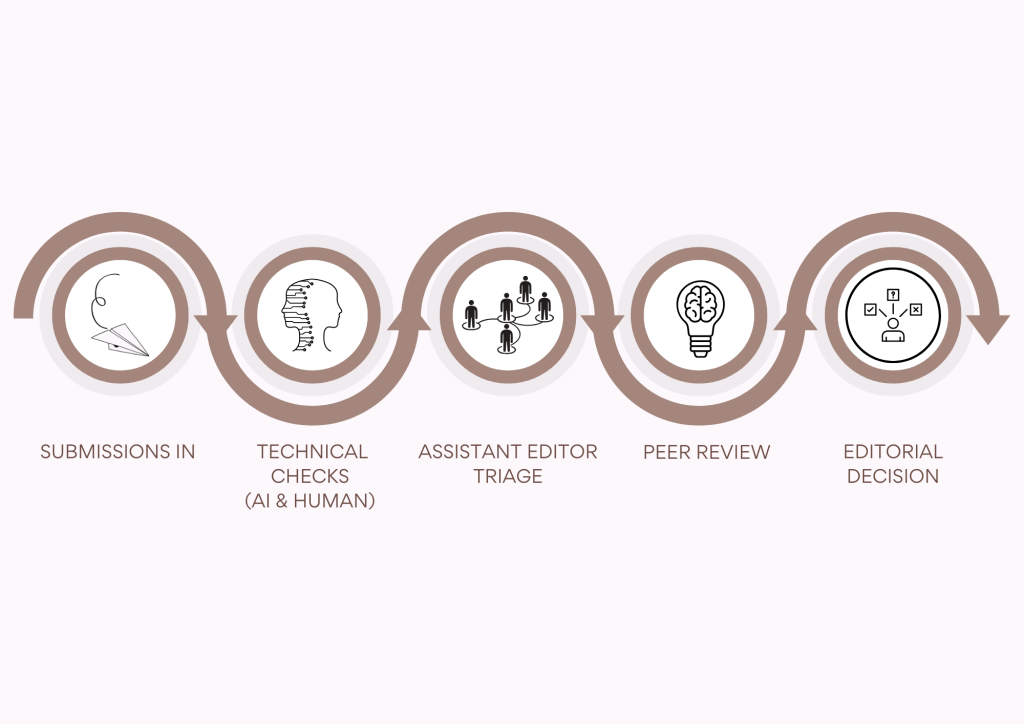
Our PA Triage EDitor service was developed in response to this shift. Delivered by subject specialists aligned to journal needs, the service combines structured editorial assessment with carefully integrated integrity screening tools where appropriate. This includes scope and fit review, manuscript checks, integrity screening, and contextual editorial analysis designed to support (not replace) editorial decision-making.
While AI-assisted tools can help identify patterns, anomalies, or areas requiring further attention, interpretation remains essential. Editorial judgement still depends on context, disciplinary understanding, proportionality, and experience. A flagged similarity score, image concern, or unusual submission pattern is rarely meaningful in isolation. Understanding whether an issue represents genuine concern, misunderstanding, poor reporting practice, or something more serious still requires human oversight.
For us, ‘human-in-the-loop’ is not a branding phrase; it shapes how editorial decisions are considered operationally. It is an operational principle that underpins how we approach editorial support more broadly. Technology may assist workflows, improve visibility, or reduce administrative burden, but experienced editorial professionals remain the most important part of the process. The goal is not to remove human judgement from peer review management; it is to strengthen and support it.
This thinking also extends beyond new submissions.
As research integrity scrutiny increases, publishers are also revisiting previously published content more systematically. High-profile retractions, paper mill activity, manipulated images, and increasing expectations around publication ethics have highlighted the importance of safeguarding the scholarly record not only for new submissions but also across existing journal archives.

In response, we developed PA Archive EDitor to support structured post-publication review, retrospective integrity screening, audit support, and escalation reporting for published content. Using the same subject-specialist editorial approach that underpins our PA Triage EDitor service, Archive EDitor supports publishers in identifying and handling potential concerns that may not have been visible during the original editorial and peer review process.
Archive review is not simply about identifying problematic content; it is about helping organisations strengthen oversight, understand risk more clearly, and respond consistently and confidently to growing integrity concerns. This may include supporting the editorial and operational processes that follow screening outcomes, such as documentation, editorial escalation, author communication, and the implementation of appropriate corrective actions where required.
Retrospective review requires a careful balance. Publishers need robust oversight, but also approaches that are transparent, proportionate, and operationally manageable. In this area especially, human interpretation remains critical. Archive review is not simply about identifying problematic content; it is about helping organisations strengthen oversight, understand risk more clearly, and respond consistently to growing integrity concerns.
Alongside these services, we are also seeing growing demand for support around workflow redesign, platform migration, tool integration, and broader operational change management. Many editorial teams are currently balancing new technologies, evolving policies, staffing pressures, and changing submission systems all at once. Even well-designed systems fail if editorial workflows become harder for people to use in practice.

Our Change Management support focuses on precisely this area: helping publishers adapt workflows, embed new tools, support stakeholder adoption, and manage operational transitions in ways that remain sustainable for editorial teams in practice, not just in theory. Throughout these changes, we believe the human side of editorial operations should remain central to how workflows are designed and supported.
Across all of these services, one theme remains consistent: the demands being placed on editorial workflows are becoming more complex, but the strongest systems are unlikely to be the ones that pursue automation alone. More often, they will be the systems that combine technology with experienced editorial oversight, operational flexibility, and a practical understanding of how peer review works in the real world.
The future of scholarly publishing will undoubtedly involve increasingly sophisticated tools, more integrated workflows, and greater emphasis on research integrity and accountability.
As an independent editorial services provider, PA EDitorial is consciously not tied to any single publisher platform, technology provider, or workflow model. This allows us to work flexibly alongside a range of systems, tools, and industry partners, helping journals adopt the approaches that genuinely fit their editorial needs rather than forcing workflows around a single solution.
For us, maintaining that flexibility and transparency matters because scholarly publishing still depends on people: editors, reviewers, authors, and editorial teams whose judgement, expertise and trust remain central to the integrity of the research record.
Publishing workflows will continue to evolve, and editorial technology will continue to advance. But peer review still depends on interpretation, judgement, and disciplinary understanding. Those are human responsibilities, and they remain central to maintaining trust in scholarly publishing.


If these are challenges your editorial team is currently navigating, we are always happy to discuss how different models of editorial support are working across the wider publishing landscape. Explore our services above or get in touch with the team here.