
Sarah Hands, Operations Manager, PA EDitorial
The shortage of qualified peer reviewers is not new, but the ‘crisis’ is intensifying.
Rising international research output, increasing expectations for fast turnaround of manuscripts, and limited recognition for reviewers have all contributed to ‘reviewer fatigue’. Now, the rapid adoption of AI tools in research and writing is adding further pressure on the system.
This year’s Peer Review Week theme, ‘Rethinking Peer Review in the AI Era’, highlights how AI is reshaping scholarly publishing and prompting us to rethink long-standing processes. While AI tools bring exciting opportunities, they also introduce new challenges that require careful navigation. Without new interventions, the growing volume of manuscripts, due to AI-assisted writing, risks overwhelming already overburdened editors and reviewers, with many papers being of low quality or out of scope. The result is increased reviewer fatigue, slower decision times, and even less willingness to engage in peer review.
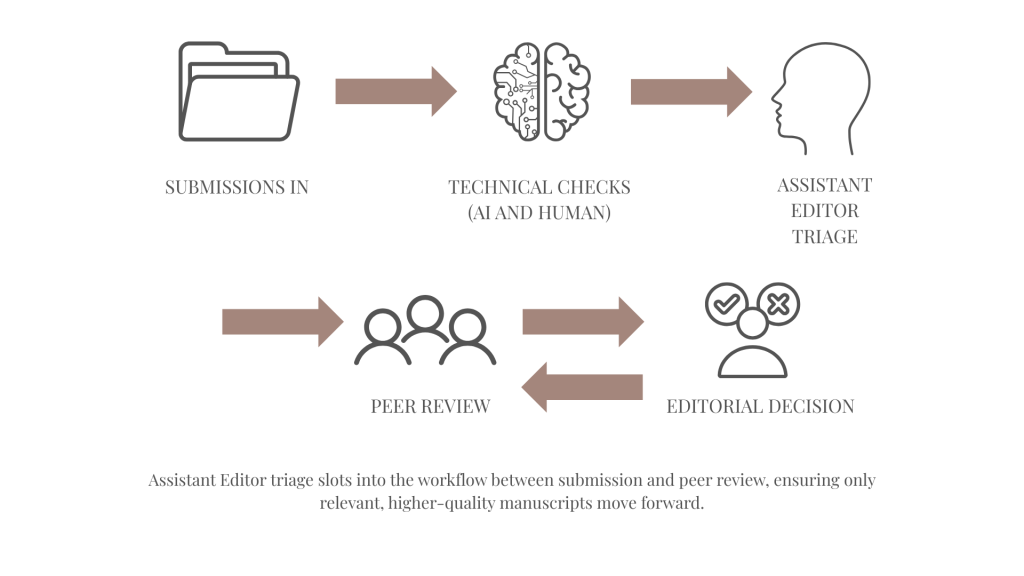
One approach to this problem is to introduce assistant editor triage: a structured, human-led review of manuscripts that incorporates AI tools before a manuscript enters the formal peer review process. This step reduces the number of unsuitable papers handled by academic editors and sent out for review. We argue that the result of this triage is improved reviewer engagement and editor focus, in turn protecting the integrity and sustainability of the peer review process.
What is Assistant Editor Triage?
Assistant editor triage is a pre-review assessment carried out by a subject specialist, often with a PhD-level background, who may not be actively engaged in research but still brings a deep understanding of the discipline. Before a manuscript is assigned to an academic editor or sent for peer review, the assistant editor evaluates:
- Scope – Does the submission fit the journal’s aims and readership?
- Quality and completeness – Are methods, data, ethics, and reporting standards adequate?
- Likelihood of acceptance – Does the submission meet baseline novelty and journal requirements?
Submissions that clearly fall short in these areas can be rejected early or returned to authors with targeted feedback. Those that are promising but incomplete can be improved before review. The result is that fewer unsuitable manuscripts are on reviewers’ and editors’ desks, and reviews can be more focused on the actual content. The use of subject experts and AI tools means that this screening process is efficient and effective in ensuring manuscripts follow the right path, and that reviewers receive quality submissions to review, encouraging them to accept future review requests. It also helps to speed up turnaround times for journals, as inappropriate manuscripts are rejected early, and editors and reviewers can focus on the lower volume of quality manuscripts.
Why It Matters in the AI Era
AI is reshaping scholarly publishing in several ways, not least in terms of:
- Volume – AI-assisted tools enable faster manuscript production, increasing the volume of submissions.
- Complexity – AI-generated or AI-edited text may disguise missing methodology, weak data, or subtle ethical issues that require expert human scrutiny.
While AI detection tools can help identify patterns, they can’t replace expert human judgement. This, in turn, adds a burden to editors, as they have increased output to analyse. Many providers of AI tools are focused on assisting editors by providing them with analytical tools, but the reality, in our experience at PA EDitorial, is that editors simply don’t have time to analyse the (no doubt useful) output that these tools provide.
Editors frequently struggle with the output from established tools, such as iThenticate, requiring advice and/or input from our managing editors. Therefore, the likelihood of editors having the time and inclination to handle output from further tools, despite a clear understanding of the importance of the output, remains low. And if editors don’t have time to fully screen the manuscripts and respond to flags, the risk is that more manuscripts than necessary are sent out to reviewers.
Assistant editor triage ensures that human oversight happens after initial AI screening but before reviewer time is spent; it can be particularly useful in identifying ‘AI slop’ that dilutes the cutting edge of research.
It’s important to acknowledge that manuscript assessment is not always clear-cut and can be subjective. In such cases, a clear route for discussion between assistant editors, publishers and helps ensure that issues and contributions are not overlooked.
Benefits for the Peer Review System
The benefits of assistant editor triage can be summarised as follows:
- Reduces the number of papers sent to editors and reviewers by filtering out unsuitable manuscripts early.
- Improves reviewer engagement – reviewers are more likely to be willing to participate when manuscripts that are sent to them are relevant, high quality, in-scope and without major ethical concerns.
- Speeds up decision-making by reducing the number of papers in full review and allowing editors to focus on the assessment of manuscripts once they have been fully peer reviewed.
- Enhances journal reputation by maintaining consistent editorial standards.
In short, assistant editor triage strengthens the balance between efficiency and quality, two essentials in today’s publishing environment.
Beyond Backlog Management
In our experience at PA EDitorial, assistant editor triage is often used as a short-term measure to assist with editor overwhelm and reduce and/or control backlogs. However, we believe there is a strong argument for making it a permanent fixture in editorial workflows. The introduction of the use of AI tools for integrity screening has effectively added a whole new step in the peer review process, and it is somewhat realistic to expect editors alone to absorb the full burden of this additional step.
By relieving editors of initial scope and integrity screening duties, assistant editor triage enables them to focus on sending out only the manuscripts that truly merit peer review, alongside analysing reviewer reports and making informed decisions based on them. This targeted allocation of work makes the whole system more sustainable.
Case Studies
At PA EDitorial, we have several examples of where this type of triage has provided significant benefits to journal operations.
Case study 1 – After implementing assistant editor triage through PA EDitorial, Journal X reduced the time to first decision by 52% within a year, despite an increase in the number of submissions. The turnaround time for rejection fell by 46%. Journal editors reported being able to refocus on core academic duties, which increased their engagement and enthusiasm for the journal. As a result, journal operations are now more consistent, efficient, and resilient.

Case Study 2 – PA EDitorial was engaged to support a prestigious, high-volume journal struggling with severe delays and an overwhelmed Editor-in-Chief. Almost every submission was being sent out for peer review. To address this, we implemented a rigorous triage system for both new and legacy submissions. Since its introduction, nearly one in seven submissions, over 700 papers so far in 2025, have been filtered out before reaching reviewers.
This has spared reviewers from hundreds of unnecessary invitations and allowed editors to focus their time on the most promising papers. While the acceptance rate has decreased, there is now greater confidence that published articles are of high quality and truly aligned with the journal’s scope.

A Better Alternative to Paid Peer Review
Some propose paying reviewers as a solution to the reviewer availability crisis. However, this risks replacing active researchers with paid subject experts who may not be engaged in the research community, undermining the whole principle of peer review. Peer review is rooted in a sense of academic duty, and introducing payment could shift motivation from scholarly contribution to financial reward, potentially incentivising speed over quality. It could also introduce disparity between journals and publishers due to the financial burden and variability in reviewer fees.
Assistant editor triage allows journals to respect and protect reviewer and editor time by removing parts of the process that can be handled by a combination of AI and editorial staff. This improves reviewer availability and engagement. It is also important to acknowledge the continued importance of reviewer recognition in other, non-financial ways, such as formal credit (e.g. Publons, ORCID), institutional acknowledgement of reviewing as part of a research role, and discounts on article processing charges (APCs).
While the benefits of assistant editor triage are clear, it’s important to recognise that successful implementation depends on alignment with established best practices. Resources such as COPE’s Core Practices and training modules [1] are vital in ensuring consistency and integrity in editorial decision-making. At the same time, a practical limitation should be acknowledged: triage requires initial investment in training, and some editors may be reluctant to delegate aspects of manuscript assessment. Recognising these challenges underscores the importance of a structured, well-supported approach, which ultimately makes the benefits of triage more sustainable.
Looking Ahead
As AI becomes further embedded in research and publishing, journals need workflows that combine human judgement with technological tools. Assistant editor triage is a scalable, adaptable, and human-centred intervention that helps keep peer review rigorous and sustainable, while preserving the very foundations of scholarly publishing.
We’d be delighted to discuss further how assistant editor triage can make a real difference for your journal; reach out to us at info@paeditorial.co.uk to start the conversation.

References
[1] https://publicationethics.org/guidance/guideline/principles-transparency-and-best-practice-scholarly-publishing